About Lulang Forest
Lulang Forest, poetically translated from Tibetan as "Dragon King Valley" or affectionately known as "A place that will make you forget your home," represents a profound, fairytale-like departure from the typical conc...
Lulang Forest, poetically translated from Tibetan as “Dragon King Valley” or affectionately known as “A place that will make you forget your home,” represents a profound, fairytale-like departure from the typical conception of the Tibetan landscape. Situated within the Bayi District of Nyingchi, this region completely shatters the stereotype of a barren, oxygen-starved, desolate high plateau. Instead, visitors are suddenly swallowed by a massive, intensely lush ocean of green—a seemingly endless sea of primeval spruce and fir trees that thickly blankets the rolling hillsides of the Serkyem La Pass.
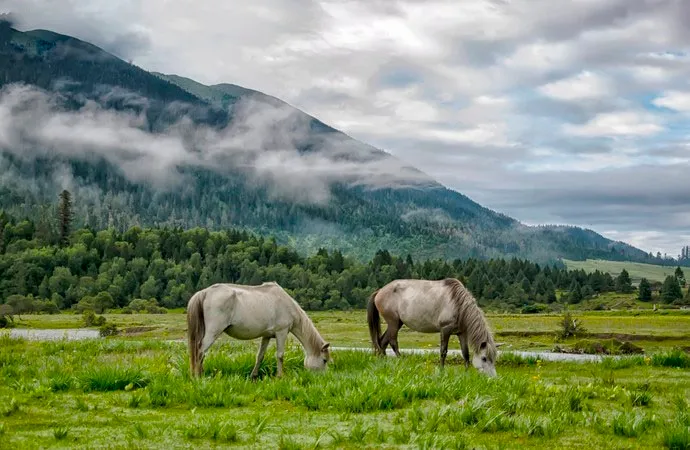
Hidden deep within this immensely dense, multi-layered alpine forest lies the impossibly picturesque Lulang Meadow. This vast, flat valley floor is heavily carpeted with an explosion of vibrant wild alpine flowers. Meandering, crystal-clear streams casually crisscross the vibrant green pastures where indigenous Dzo (a hardy yak-cow hybrid), Tibetan pigs, and wild horses graze with absolute tranquility. It is the epitome of pastoral highland perfection.
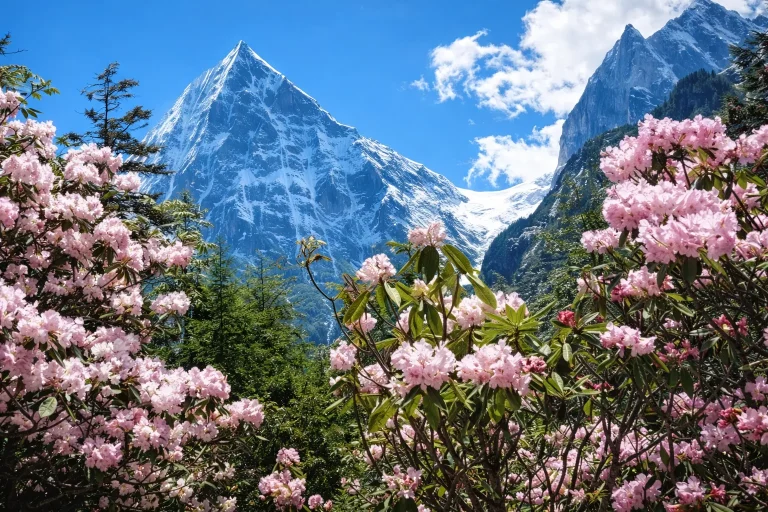
When the sky clears, the scenic composition becomes almost unbelievable: the foreground bursts with intensely green forests and sprawling flower fields, while the background is completely dominated by the shockingly high, jagged, glacier-clad peaks of Mount Namcha Barwa and Mount Gyala Peri towering into the heavens. This flawless merging of deep forests, idyllic pastures, and formidable snow mountains has rightfully earned Lulang the celebrated international title of the “Swiss Alps of Tibet” and arguably the greatest “natural oxygen bar” on the entire plateau.
↺ History
For long centuries, the Lulang valley was a relatively secluded, moisture-rich sanctuary inhabited exclusively by Gongbo Tibetan farmers and nomadic herders. Its unique existence is a direct geographical miracle born from the mighty Yarlung Tsangpo Grand Canyon. Serving as a colossal funnel, the canyon continually channels warm, incredibly humid monsoon air currents directly from the Indian Ocean up into this specific high-altitude pocket. This geographical quirk completely insulated Lulang from the brutal, arid harshness that defines the rest of the Tibetan plateau, fostering a ridiculously rich, isolated biodiversity.
Historically, prior to the construction of modern asphalt roads, crossing through Lulang was a notoriously grueling segment of both the ancient Tea Horse Road and the classical Sichuan-Tibet trade route. Merchant caravans heavily laden with tea bricks and highland salt had to slog through deep, terrifyingly muddy tracks hidden within these perpetually rain-soaked, predator-filled primeval forests just to conquer the towering Serkyem La Pass.
In the modern era, recognizing the absolute scarcity and world-class potential of this ecological diamond, Lulang underwent a staggering transformation. With massive, multi-billion-yuan investments (spearheaded largely by Guangdong province), this once-remote forestry outpost has been brilliantly redeveloped into the “Lulang International Tourist Town.” It is now a premium, highly sought-after resort destination that seamlessly fuses traditional Gongbo Tibetan architectural art with modern luxury hospitality.
Recommended Tours
View All
3 Days / 2 Nights ★ 4.8
3 Days Nyingchi Grand Canyon & Basum Tso Tour
6 Days / 5 Nights ★ 4.8
6 Days Tibet Panorama Tour with Nyingchi, Everest & Namtso
3 Days / 2 Nights ★ 4.8
3 Days Everest Base Camp Tour from Lhasa
How To Get There
Lulang Forest occupies an extremely strategic and unavoidable position directly on the world-famous National Highway 318 (G318), the legendary highly transited “Sichuan-Tibet Highway,” approximately 75 kilometers east of Bayi Town (the modern urban center of Nyingchi).
Departing eastward from Bayi Town, vehicles are immediately challenged by the formidable ascent of the Serkyem La Pass (elevation 4,728 meters)—which is, incidentally, one of the premier panoramic observation decks closely facing the magnificent peak of Mount Namcha Barwa. Immediately upon cresting the pass and beginning the steep descent down the eastern slope, the landscape dramatically changes, and vehicles instantly plunge headfirst into the breathtakingly lush embrace of the Lulang Forest. This spectacularly scenic drive takes approximately 1.5 to 2 hours.
Due to its strategic location and unparalleled beauty, Lulang serves as an absolute mandatory highlight for the hundreds of thousands of hardcore overland travelers driving the heroic G318 route into Tibet. Additionally, it is a highly popular, standalone day-trip or overnight getaway for tourists basing themselves in Nyingchi city or arriving via the high-speed railway from Lhasa.
ⓘ Travel Tips
- The Ultimate Plateau Delicacy—Lulang Stone Pot Chicken: It is a universally acknowledged truth among travelers that you absolutely cannot pass through Lulang without devouring its legendary "Lulang Stone Pot Chicken" (鲁朗石锅鸡). The magic lies in the cooking vessel—an incredibly heavy pot manually carved from extremely rare, heat-retaining soapstone sourced exclusively from the remote Medog County. Locally raised, free-range chicken is slow-stewed in this pot alongside a massive abundance of fiercely guarded Tibetan medicinal herbs, including the highly prized "hand palm ginseng" (手掌参) and incredibly rare wild forest mushrooms. The resulting milky-white broth is explosively rich and uniquely fragrant.
- Oxygen-Rich but Highly Unpredictable Weather: Thanks to the impossibly dense vegetation, the oxygen levels in Lulang are remarkably high, and the humidity is comfortable. Severe altitude sickness here is exceedingly rare, making it an incredible place to sleep deeply and recover. However, the weather inside this valley is notoriously bipolar. Summer (June-August) brings almost daily rainfall. A brilliantly sunny morning can violently shift into a chilling, fog-choked rainstorm within minutes. High-quality rain gear, waterproof hiking shoes, and warm layers are absolute necessities. The ethereal morning mist suspended directly in the pine branches is hauntingly beautiful but bone-chillingly damp.
- Official Platforms vs. Free Exploration: As you descend from the pass along the G318, you will encounter the official, ticketed "Lulang Forest Viewing Platforms" (entrance approx. 90 CNY). These platforms extend over sheer drops and offer the absolute best, sweeping bird's-eye panoramas of the vast "ocean of trees" framed against the snow peaks. However, if you prefer not to pay, you can simply continue driving down to the valley floor into Lulang Town. Here, you can freely park by the roadside, stroll along expansive wooden boardwalks directly into the flower-filled meadows, and physically immerse yourself in the idyllic scenery at zero cost.
Enjoy Visa-Free Travel To China & Tibet
China has expanded visa-free entry policies for more countries. Our team can help confirm your route, permits, and documents before departure.
Gallery