About Dangra Yumtso
Dangra Yumtso, located in Nyima County of the Nagqu Prefecture, is the fourth-largest lake in Tibet, sitting at an elevation of approximately 4,528 meters and covering an area of roughly 836 square kilometers. Dangra ...
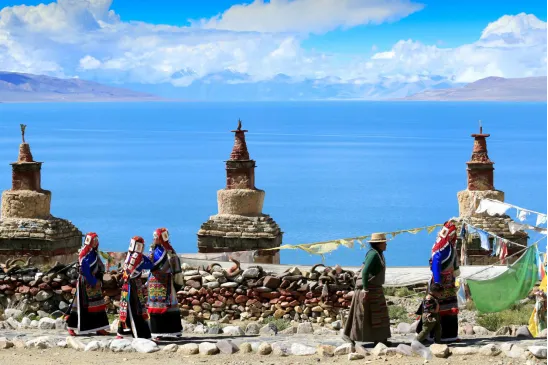
Dangra Yumtso, located in Nyima County of the Nagqu Prefecture, is the fourth-largest lake in Tibet, sitting at an elevation of approximately 4,528 meters and covering an area of roughly 836 square kilometers. Dangra Yumtso holds supreme religious significance as the most sacred lake of Bon, the ancient indigenous pre-Buddhist religion of Tibet—its status within the Bon faith is comparable to that of Lake Manasarovar or Namtso within Tibetan Buddhism. The lake stretches in an elongated north-south orientation, nestled within a tectonic rift valley flanked by the Dargye Snow Mountains and surrounding ranges. Its waters display an extraordinarily pure, multi-layered color gradient transitioning from light blue and emerald green to deep sapphire, depending on depth and light conditions.
Dangra Yumtso remains one of the least known and least commercially developed major lakes in all of Tibet. The lakeshore is virtually devoid of modern tourist infrastructure, preserving an exceptionally pristine natural landscape. The primary human settlements along the eastern shore are Wenbu South Village and Wenbu North Village, whose residents are predominantly Bon practitioners who maintain unique Bon religious ceremonies and traditional lifestyles to this day. On clear days, the Dargye Snow Mountains reflect perfectly upon the deep blue lake surface, while scattered Tibetan houses and grazing livestock dot the shoreline, composing an extraordinarily serene and unembellished highland pastoral scene.
↺ History
Dangra Yumtso is venerated in Bon scriptures as one of the most sacred lakes in existence. Bon is the indigenous religion native to Tibet, predating the arrival of Buddhism by several centuries. In the sacred geography of the Bon faith, Dangra Yumtso and the adjacent Dargye Snow Mountain (approximately 6,632 meters) together form a revered “Sacred Mountain and Holy Lake” pairing of the highest spiritual importance. The lakeshore and surrounding areas historically served as major pilgrimage destinations and meditation retreats for Bon devotees, and to this day the Wenbu villages preserve distinctly Bon practices, most notably the counter-clockwise circumambulation direction (opposite to the clockwise direction used in Buddhism).
Historically, the Nyima County region surrounding Dangra Yumtso formed part of the core territory of the ancient Zhang Zhung Kingdom. Zhang Zhung was a pre-Tibetan Empire civilization on the Qinghai-Tibet Plateau and the birthplace of the Bon religion. Although very few physical remains of the Zhang Zhung civilization survive, the living Bon traditions and cultural customs preserved around Dangra Yumtso are considered among the most authentic surviving cultural vestiges of this ancient kingdom. In recent years, Dangra Yumtso has gradually been discovered by intrepid deep-travel enthusiasts and explorers, but due to its extreme geographic remoteness, overall tourism development remains very limited and the pristine landscape is well preserved.
Recommended Tours
View All
6 Days / 5 Nights ★ 4.8
6 Days Tibet Panorama Tour with Nyingchi, Everest & Namtso
3 Days / 2 Nights ★ 4.8
3 Days Nyingchi Grand Canyon & Basum Tso Tour
3 Days / 2 Nights ★ 4.8
3 Days Everest Base Camp Tour from Lhasa
How To Get There
Dangra Yumtso is located within Wenbu Township of Nyima County, Nagqu Prefecture, approximately 130 kilometers from the Nyima county seat. Nyima County lies roughly 1,100 kilometers from Lhasa and about 580 kilometers from the Nagqu urban center. Situated deep in the interior of northern Tibet, transportation conditions are relatively challenging.
The most common route from Lhasa to Dangra Yumtso follows the “Ngari Grand North Line” itinerary, typically requiring multiple days of driving. An alternative route proceeds from Lhasa along the G317 National Highway through Nagqu city to Nyima County, then turning toward Wenbu Township, with the entire journey taking approximately 2 to 3 days. Some road sections consist of unpaved dirt tracks or basic surfaces, with conditions varying significantly according to weather. During the rainy season, certain sections may become muddy and difficult to navigate. A reliable four-wheel-drive vehicle with an experienced driver is strongly recommended for the entire journey. Dangra Yumtso has no scenic area management facilities or ticket offices and is an entirely open, undeveloped natural landscape. Wenbu South Village offers a small number of family-run guesthouses providing basic accommodation under simple conditions.
ⓘ Travel Tips
- Extreme Remoteness and Limited Supplies: Dangra Yumtso is one of the most remote major attractions in Tibet. The roughly 130-kilometer stretch from the nearest town of Nyima to the lake area offers extremely limited supply options. Before departure, visitors must stock up on adequate fuel, drinking water, food, and emergency medical supplies in Nyima or earlier towns. Mobile phone signal is essentially nonexistent in the lake area.
- High Altitude Precautions: The lake area sits above 4,500 meters elevation. Combined with the dry, cold climate and strong winds characteristic of northern Tibet, the risk of altitude sickness is considerable. It is recommended to spend at least 3 days acclimatizing in Lhasa before venturing deep into northern Tibet. Carry oxygen equipment and common medications at all times.
- Respecting Bon Culture: The Wenbu villages are traditional Bon faith communities. Bon religious customs differ notably from Tibetan Buddhism, most visibly in the practice of counter-clockwise circumambulation (Buddhism uses clockwise). When visiting villages and religious sites, please respect local customs and obtain permission before taking photographs.
- Accommodation Conditions: Wenbu South Village offers a small number of family guesthouses providing simple bed spaces and basic Tibetan meals, but conditions are very rudimentary with no guarantee of hot water. Bringing a personal sleeping bag to cope with nighttime low temperatures is recommended, and visitors should be mentally prepared for a very basic lodging experience.
Enjoy Visa-Free Travel To China & Tibet
China has expanded visa-free entry policies for more countries. Our team can help confirm your route, permits, and documents before departure.
Gallery