About Basum Tso
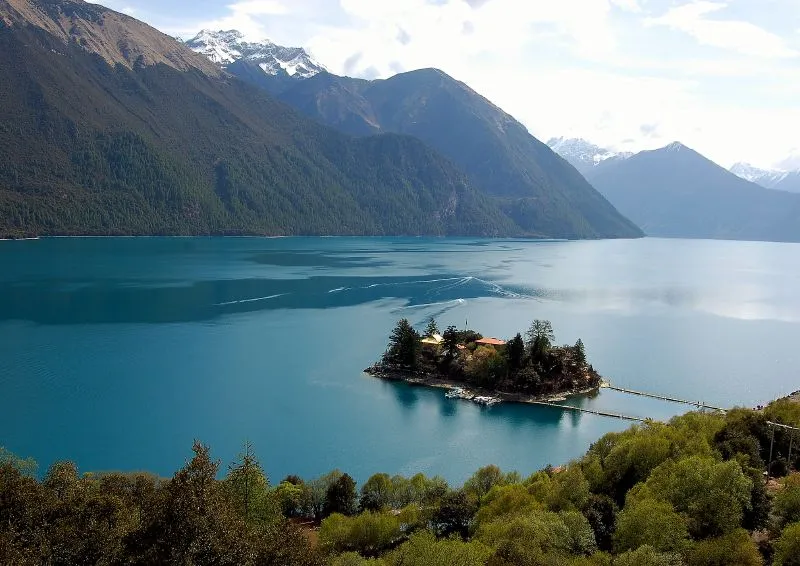
Basum Tso (appropriately translating to "Green Water" in Tibetan) is a mesmerizing, crescent-shaped alpine lake tucked deep within a steep gorge in Gongbo'gyamda County, Nyingchi. For travelers arriving from the barre...
Basum Tso (appropriately translating to “Green Water” in Tibetan) is a mesmerizing, crescent-shaped alpine lake tucked deep within a steep gorge in Gongbo’gyamda County, Nyingchi. For travelers arriving from the barren, oxygen-starved high plateau of central and western Tibet, Basum Tso feels like entering a completely different world. It perfectly embodies Nyingchi’s reputation as the “Switzerland of Tibet.” The massive, 18-kilometer-long lake is tightly embraced by incredibly dense, primeval pine and fir forests that descend right to the water’s edge, with a spectacular backdrop of jagged, glacier-clad peaks soaring over 5,000 meters into the sky.
The lake’s most spellbinding feature is the otherworldly color of its water. Depending on the weather and the angle of the sun, Basum Tso transitions between a translucent emerald green and a deep, milky jade. When the skies are clear, the impossibly vibrant reflection of the surrounding dense, dark green coniferous forests and the blindingly white snow-capped mountains on the absolutely still surface of the lake creates a visual masterpiece of explosive color and multi-layered depth.
The undisputed centerpiece and most iconic photographic focal point of the entire scenic area is Tashi Island (Zhaxi Island). Seemingly floating magically in the center of the jade waters, this tiny, densely wooded islet is connected to the mainland by two long, picturesque floating pontoon bridges. Shrouded in morning mist, the island looks like an ethereal, untouched fairy-tale sanctuary isolated from the mortal realm.
↺ History
Basum Tso is far more than just a spectacular 5A-level national scenic area; it holds an incredibly profound and revered status in Tibetan Buddhism. Recognized as the largest sacred lake of the Nyingma sect (the ancient Red Hat sect) in eastern Tibet, the entire valley is saturated with mystical religious legends and creation myths, most notably those centered around the great tantric master, Guru Rinpoche (Padmasambhava).
Hidden under the canopy of ancient trees in the very center of the tiny Tashi Island lies the Tsozong Dzongba Monastery. Built in the 13th century (making it nearly 800 years old), this modest but immensely significant Nyingma temple possesses two highly unusual characteristics. First, it features explicit phallic wood carvings near its entrance—a very rare sight in mainstream Tibetan monastic architecture, symbolizing the ancient Gongbo Tibetan tribes’ primal worship of fertility and life. Second, the island’s boulders are said to bear the miraculous “natural impressions” of deities, heavily impressing pilgrims with stones claiming to show the footprints of Guru Rinpoche and the hoofprints of King Gesar’s legendary warhorse.
Indeed, the geography of the entire Basum Tso valley is deeply interwoven with the epic, semi-mythical tales of King Gesar of Ling. Many of the surrounding snow peaks and ravines are named after his legendary battles and generals, infusing this lush natural paradise with a strong sense of classical, heroic Tibetan romance.
Recommended Tours
View All
3 Days / 2 Nights ★ 4.8
3 Days Nyingchi Grand Canyon & Basum Tso Tour
6 Days / 5 Nights ★ 4.8
6 Days Tibet Panorama Tour with Nyingchi, Everest & Namtso
3 Days / 2 Nights ★ 4.8
3 Days Everest Base Camp Tour from Lhasa
How To Get There
Basum Tso is located within Bahe Town of Gongbo’gyamda County in the Nyingchi Prefecture. Geographically, it sits roughly midway between Lhasa and the Nyingchi city center (Bayi Town), requiring a scenic 40-kilometer detour deep into a branch valley off the famous National Highway 318 (the Sichuan-Tibet Highway).
With the completion of the magnificent Linla High-Speed Highway (the expressway connecting Lhasa and Nyingchi), traveling to Basum Tso has become unprecedentedly fast and comfortable. Departing from the capital city of Lhasa, a smooth, continuous highway drive of approximately 3.5 to 4 hours will deliver you directly to the grand entrance of the scenic area. If departing from Nyingchi city (Bayi Town), the drive takes merely 1.5 to 2 hours.
As with all major national protected areas in China, strict environmental traffic controls are enforced. All private SUVs, rental cars, and commercial tour buses must be mandatorily parked in the massive lots at the visitor center outside the gate. After purchasing tickets, all visitors must transfer to the official, unified green eco-buses. These shuttle buses navigate the 10-kilometer inner scenic road hugging the lake, accurately dropping passengers off at the main observation decks and the entrance to the floating bridges leading to Tashi Island.
ⓘ Travel Tips
- The Ultimate "Low Altitude" Comfort Zone: For travelers newly arriving in Tibet who are terrified of acute mountain sickness, Basum Tso is the absolute perfect introductory "safe haven." The lake's surface sits at an elevation of "only" 3,480 meters (lower than Lhasa). More importantly, because it is surrounded by vast, dense primeval forests that actively pump out oxygen, the air here is significantly richer and the climate is wonderfully moist. The vast majority of visitors experience zero altitude sickness here, making it highly recommended for the first few days of acclimatization on the plateau.
- Two Seasons of Explosive Color: While beautiful year-round, Basum Tso reaches its absolute aesthetic peak during two specific windows. From mid-March to early April , thousands of wild highland peach trees erupt into vibrant pink blossoms against the backdrop of the jade lake and snow mountains, creating an impossibly romantic scene. In mid-to-late October , the dense alpine forests ignite into a blazing, world-class autumn palette of golden yellows and deep crimson reds, offering a breathtaking visual feast.
- Explore the "Hidden Villages" Beyond the Island: While 90% of hurried tourists only snap photos at Tashi Island and leave, the true, authentic cultural magic of Basum Tso lies deeper inside the valley. Try to take the inner scenic shuttles further in to visit the ancient, utterly isolated Gongbo Tibetan settlements of Jieba Village and Cuogao Village . Here, you can wander among incredibly unique, traditional stone-and-wood Gongbo architecture, completely untouched by modern commercialization. Spending a night in a family-run guesthouse in these villages—waking up to the serene reflection of snow peaks outside your wooden window—is the ultimate escape into pristine tranquility.
Enjoy Visa-Free Travel To China & Tibet
China has expanded visa-free entry policies for more countries. Our team can help confirm your route, permits, and documents before departure.
Gallery