About Mount Kailash
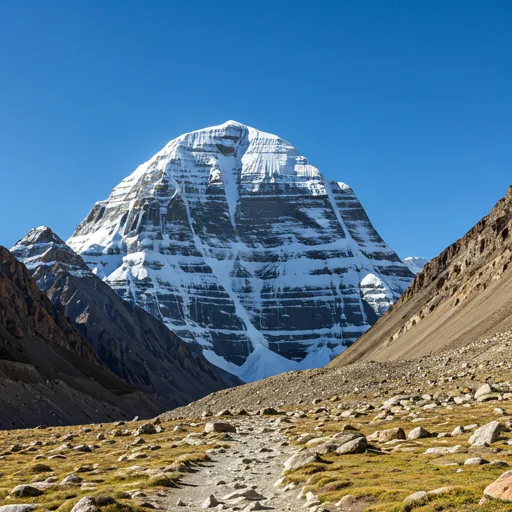
Mount Kailash (冈仁波齐), soaring to 6,656 meters in the remote wilderness of Ngari Prefecture in far western Tibet, is universally revered as the most sacred mountain on Earth. No other peak on the planet holds s...
Mount Kailash (冈仁波齐), soaring to 6,656 meters in the remote wilderness of Ngari Prefecture in far western Tibet, is universally revered as the most sacred mountain on Earth. No other peak on the planet holds simultaneously holy status in four major world religions — Hinduism, Buddhism, Jainism, and the ancient Tibetan Bon faith. To over a billion believers across Asia, Kailash is nothing less than the axis mundi, the cosmic center of the universe, the mythical Mount Meru where heaven and earth converge.
Visually, Kailash is utterly unmistakable and hauntingly beautiful. Unlike the jagged, chaotic profiles of most Himalayan giants, it rises from the surrounding plateau as a near-perfect, symmetrical pyramid of dark rock and gleaming ice. Its four sheer faces are oriented almost precisely toward the four cardinal compass points, as if deliberately placed by a divine architect. The south face is marked by a dramatic vertical cleft crossed by a horizontal rock striation, forming a shape that Buddhists and Hindus interpret as a natural swastika (卍) — an ancient symbol of spiritual power and auspiciousness. When bathed in the golden light of sunrise or sunset, the mountain transforms into a radiant, otherworldly beacon that seems to glow from within.
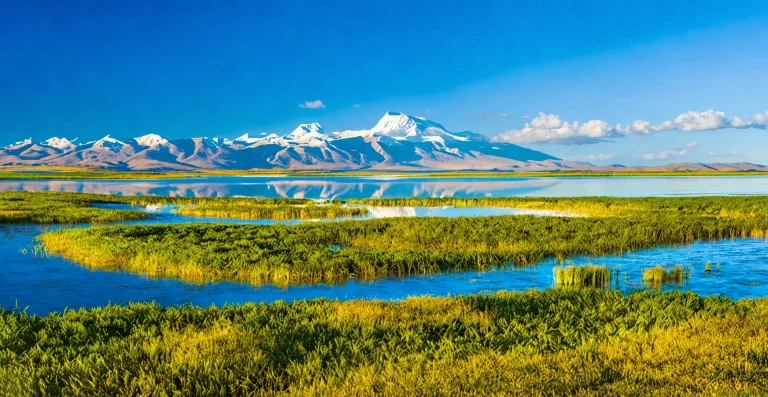
The landscape surrounding Kailash amplifies its spiritual grandeur. At its southern base lies the sacred Lake Manasarovar (玛旁雍错), one of the highest freshwater lakes in the world, whose crystalline turquoise waters are believed to cleanse all sins. Nearby stands the “demon lake” Rakshas Tal (拉昂错), a darkly beautiful, saline counterpart representing the forces of darkness. Together, the sacred mountain flanked by the holy lake and the demon lake creates a cosmic trinity of light, purity, and shadow that has captivated spiritual seekers for millennia.
↺ History
The spiritual significance of Mount Kailash stretches back thousands of years into the deepest roots of Asian civilization. In Hindu mythology, Kailash is the eternal abode of Lord Shiva, the supreme god of destruction and renewal, who sits atop the peak in a state of perpetual meditation alongside his divine consort Parvati. The Hindu epic Ramayana and the ancient Puranas describe Kailash as the center of the cosmos and the source of four great rivers that flow to the four corners of the world — a mythological concept that remarkably mirrors the geographical reality, as four of Asia’s mightiest rivers (the Indus, Sutlej, Brahmaputra, and Karnali) originate in the broader Kailash-Manasarovar region.
In Tibetan Buddhism, Kailash is intimately associated with the legendary 11th-century saint Milarepa, who is said to have engaged in a dramatic supernatural contest with the Bon shaman Naro Bönchung for spiritual dominion over the mountain. According to tradition, Milarepa triumphed by miraculously riding a beam of sunlight to the summit, thereby establishing Buddhism’s supreme authority over this sacred site. The Bon religion, however, predates Buddhism in Tibet by centuries and regards Kailash as the seat of all spiritual power, the place where their founder Tonpa Shenrab descended from heaven to earth.
Despite its supreme religious status, Mount Kailash has never been climbed. The Chinese government has officially banned all mountaineering attempts out of respect for its sacred status. In 2001, a controversial climbing permit was briefly granted to a Spanish expedition but was revoked after an international outcry from religious leaders and communities worldwide. Kailash remains the most prominent unclimbed peak on Earth — a mountain whose sanctity has triumphed over the human impulse to conquer every summit.
Recommended Tours
View All
6 Days / 5 Nights ★ 4.8
6 Days Tibet Panorama Tour with Nyingchi, Everest & Namtso
3 Days / 2 Nights ★ 4.8
3 Days Nyingchi Grand Canyon & Basum Tso Tour
3 Days / 2 Nights ★ 4.8
3 Days Everest Base Camp Tour from Lhasa
How To Get There
Mount Kailash is located in Purang County, Ngari Prefecture, in the far southwestern corner of the Tibet Autonomous Region. It is one of the most remote major sacred sites on the planet — approximately 1,200 kilometers from Lhasa by road, a grueling overland journey that takes a minimum of three to four days of driving across the vast, desolate expanses of the western Tibetan Plateau.
The two primary overland routes from Lhasa are the Southern Route (via Shigatse, Saga, and Zhongba along the G219) and the Northern Route (via Nagqu, Nyima, and Geji along the G317 before connecting south). The Southern Route is more commonly used and better-maintained, but both traverse extremely remote, high-altitude terrain (sustained elevations of 4,500-5,200 meters) with limited fuel stations, no roadside assistance, and vast stretches of absolute wilderness. A capable 4WD vehicle, an experienced driver, and advance fuel and supply planning are absolutely essential.
For those seeking to reduce the overland journey, Ngari Gunsa Airport (阿里昆莎机场), located near the prefectural capital of Shiquanhe (Lion Spring River Town), offers flights from Lhasa, Chengdu, and Kashgar. From Shiquanhe, Kailash is still approximately 260 kilometers to the south — roughly a 5 to 6 hour drive. Many organized pilgrim and tourist groups fly into Shiquanhe and then drive to the Kailash-Manasarovar area, which remains the most efficient approach for those with limited time.
ⓘ Travel Tips
- The Kora (Circumambulation): The defining spiritual and physical experience of Kailash is the Kora — the sacred 52-kilometer trek that circumambulates the entire mountain. Devout Buddhist and Hindu pilgrims complete the circuit clockwise; Bon practitioners walk counterclockwise. Most trekkers accomplish the Kora in three days and two nights , crossing the formidable 5,630-meter Drolma La Pass on the second day. This is an extremely demanding high-altitude trek — only attempt it if you are well-acclimatized, physically fit, and properly equipped. Porters and yaks can be hired at the trailhead town of Darchen to carry your gear.
- Altitude — The Most Serious Challenge: The Kailash base area sits at approximately 4,600 meters, and the Kora's highest point (Drolma La) reaches 5,630 meters. Acute Mountain Sickness (AMS) is an extremely real and potentially dangerous risk. You must spend a minimum of 3-4 days acclimatizing at progressively higher elevations before attempting the Kora. Carry portable oxygen, Diamox (if prescribed by your doctor), and monitor your group members for symptoms of severe AMS (confusion, persistent vomiting, loss of coordination) at all times. If severe symptoms appear, descend immediately.
- Permits and Regulations: Visiting the Kailash-Manasarovar area requires multiple permits: a standard Tibet Travel Permit (TTP), an Alien's Travel Permit (ATP), and a Military Area Permit for the border region. These permits must be arranged through a registered Tibetan travel agency in advance — independent travel to this area is not permitted for foreign visitors. Ensure all paperwork is confirmed well before your departure date.
- Accommodation and Supplies: Darchen (塔钦), the small town at the southern base of Kailash, serves as the gateway for the Kora and offers basic guesthouses, simple restaurants, and small shops selling instant noodles, snacks, and basic trekking supplies. Conditions are rudimentary — do not expect hot water, reliable electricity, or heating. Along the Kora trail itself, two basic monastery guesthouses (Dirapuk and Zutulpuk) provide shelter for overnight stops, but bring your own sleeping bag and food. Stock up on all essential supplies in Shiquanhe or Lhasa before heading to the Kailash area.
- Spiritual Etiquette: Mount Kailash is above all a deeply sacred site. Walk clockwise around the mountain (unless following the Bon tradition). Do not litter, shout, or play loud music anywhere on the Kora trail. Remove your hat when passing monasteries and mani stone walls. Do not step on or move any prayer stones, prayer flags, or religious offerings. If you encounter prostrating pilgrims performing the full-body Kora (which can take 2-3 weeks), give them space and do not obstruct their path. Approach this extraordinary place with the reverence it deserves.
Enjoy Visa-Free Travel To China & Tibet
China has expanded visa-free entry policies for more countries. Our team can help confirm your route, permits, and documents before departure.
Gallery